From sea to shining sea...

IMG_7251Hello Disciples World! My name is Briana Black and I am from Casper, Wyoming. I am a 2015 Disciples Peace Fellowship (DPF) Intern for the Summer at 2015! (I'm the goofy looking one in the center of the picture!)

 I have had the opportunity to be in Indianapolis, IN with two other Peace Interns, Celia Thomason and Will O’Brien,  to learn more about all of the wonderful things our denomination is doing and how I can be a resource for students all over the country. We have met with the General Minister and President, Sharon Watkins; have talked with Global Ministries; Disciples Home Ministries (DHM); the Center for Interfaith Cooperation (CIC); the Gay, Lesbian, and Affirming Disciples (GLAD); National Convocation; Green Chalice; Disciples Women; and so many more!

Our denomination has a very long arm, and are involved in so many wonderful organizations and events! I have met some amazing people this past week in Indianapolis and have learned about what Disciples are doing in the field and how they contribute to peace and justice across the world.

After training week, we three interns are headed off to all different camps to explain and promote peace and justice to our nation’s youth. We will hold workshops and activities all related to peace and justice issues of our choice and hopefully will plant some seeds of change! I am so excited to have the opportunity to discuss Human Rights issues that affect our own country and abroad. 

I look forward to visiting all the camps, meeting new and wonderful people, and sharing all of my experience! This is such an amazing experience and I am so thankful DOC has allowed me to be a part of such a cool group of people!

I will be headed to 7 camps from sea to shining sea! I am going to:

  • Camp Christian- Gordon, GA
  • Camp Caroline- Arapahoe, NC
  • Camp Couchdale- Hot Springs, AR
  • Community of the Great Commission- Foresthill, CA
  • Camp Christian- Marysville, OH
  • Loch Leven- Mentone, CA
  • Cane Ridge West- Lincoln, MT

Briana Map 

“Singing the Lord’s Song in the New Land” NAPAD Convocation 2014

I got to finish my summer in the Windy City at NAPAD Convocation. I have to admit that I was pretty tired after the many weeks at camp, but the energy and passion of the conferees helped invigorate me during my final week as a DPF intern. Lively worship, impassioned preaching, delicious food, and a memorable culture night were the highlights of my week and some of my favorite memories from the summer.

Convocation presented many opportunities to discuss social justice issues and challenges unique to NAPAD congregations. Our first day began with anti-racism training. The session encouraged us to look at the role race has played in the history of the US and to see how racism continues to adversely affect our society. Later on I had the opportunity to give two presentations to the youth, one on key leaders of the Civil Rights Movement and another on just war, pacifism, and faithful responses to conflict.

Our keynoters, Drs. Russell Moy and Russell Yee, helped us understand the challenges facing immigrants to the US to worship in ways that honor their culture and heritage. Discovering a unique voice in a new land, regardless of how long one has lived there, is a difficult task, especially when confronted with the expectations and traditions of the dominant culture. Our speakers also gave us a crash course in biblical geography, reminding us that the majority of the stories and important figures in the Bible came from Asia and Africa. Abraham “from Ur of the Chaldees” was likely from modern-day Iraq, Paul was from Turkey, and the Israelites spent quite a few years in Africa while in bondage to the Egyptians. Needless to say, these biblical figures moved a lot during their lives and were often immigrants and strangers in new lands.

Although the workshops and presentations were interesting, the fellowship, worship, and celebrations are what I will remember the most from convocation. I discovered how much fun it is to get covered in paint, to stay up late playing cards while feasting on ramen noodles and candy, and to dance the haka. I tried new foods from Korea, Samoa, and the Philippines. I enjoyed the beautiful dances and music that were shared during our worship services. I was moved by the powerful prayers we offered together, each person praying in his or her own tongue, for healing and unity in our church and world. And I got to partake in and enjoy the performances at cultural night where people were free to express themselves in beautiful music, art and dance.

NAPAD Convocation was a highlight of my summer, and I hope I have the opportunity to attend again two years from now. Like my experiences at camps, I met amazing people, had meaningful discussions, and had the chance to spend time in a beautiful place. I am sad to end my summer as a DPF intern, but I know the memories and friendships I made will continue to live on and inspire me for years to come.


Jonathan Cahill is a 2014 Disciples Peace Fellowship Intern, sponsored by Federated Church of West Lafayette.

It's All Greek to Me

College classes started early for me this summer.  I got to visit Bethany College for the first time as part of the West Virginia region’s CYF conference and felt right at home staying on a college campus.  Bethany is a “small college of national distinction,” steeped in Disciples’ history and located atop the beautiful mountains of West Virginia.  The campus brings back memories of both our nation’s and our denomination’s rich past.  I counted at least five plaques dedicated to US Presidents who had visited Bethany, and I learned about the frequent visits James Garfield made to see his friend Alexander Campbell.  Our tour of the Campbell Mansion allowed me to join a long list of guests to the home, putting me in the company of such notables as President Garfield and Jefferson Davis.  My stroll through the neighboring graveyard gave me the chance to pay my respects to the Campbell family, several former presidents of Bethany College, and many other prominent members of the Christian Church.

Learning about the history of Bethany would have kept me busy enough for the week, but CYF conference and my duties as a peace intern kept me occupied as well.  The peace and justice interest group was kept busy reflecting on unearned privilege in the U.S.  We also looked at our nation’s complicated relation to race and the turbulent times of the Civil Rights Movement.  Watching footage of politicians spewing virulent racism from the podium, of police arresting peaceful marchers and unleashing dogs on children, and of the trial of the murderers of Emmett Till gave us a chilling reminder of the wounds that still scar our history.  These images stood in stark contrast to the passionate calls for justice of the congregants in Dexter Avenue Baptist Church in Montgomery, to the commitment to non-violence of the college students being spat on and beaten at a Woolworth’s lunch counter, and to the courage of Moses Wright who was likely one of the first black men to accuse a white man of murder in a Mississippi courtroom and live.

Looking back on our nation’s past gave rise to discussion on problems we still face today.  The high school students recognized that stereotyping and bullying continue to plague our society, being especially damaging in our schools.  They wrestled with the challenge of poverty, learning firsthand its effects while preparing meals and doing other volunteer work at the Wheeling soup kitchen.  The students also had the opportunity to buy and collect school kits for distribution by Church World Service to children across the globe.  (For more information on this project, follow this link to Church World Service’s website: http://www.cwsglobal.org/get-involved/kits/school-kits.html).

By the end of the week, most of us were pretty exhausted from the days of service, worship, and discussion.  Spending the week in Bethany’s dorms brought back fond memories of my not-so-long-ago tenure as a college student.  The week also assured me that there are many more young people committed to learning, service, and justice who will soon take up their studies at colleges across the country.  Our past presents many problems for us today, but I am confident that there are leaders who will rise to tackle and overcome these challenges.


Jonathan Cahill is a 2014 Disciples Peace Fellowship Intern, sponsored by Federated Church of West Lafayette.

To be continued...

The summer is over, well almost. I’m sitting on a balcony in Portland, Oregon still amazed and bewildered about what happened over the past two months. I blinked and my summer as a Peace Intern was ending with my last closing circle. Strangely enough, however, my real job as a Peace Intern is just beginning. Over the past two months, my life has been completely changed. The way I have looked at the world has completely changed, and more importantly, the role I expect myself  to play in the world has completely changed. I have carried a message of love, compassion, and empathy with me all summer and I have challenged campers and counselors to recognize the injustices of our world through questions, stories and discussions. Truthfully, I feel like I can say I have accomplished a lot, but I know that this summer was just the first step on a long road in finding peace and justice in the world. I’ve left myself no choice but to continue to challenge others, ask questions, and engage in discussions. Otherwise, I’d be wasting the opportunity and challenge I was blessed with these past two months.

For the last two months I’ve been at camp, which to me is the most loving, accepting, and inclusive environment I’ll ever find myself in. The camp setting is a perfect setting for challenging others to look at the world differently because it is there that we are most open to new experiences and thoughts. Now, it is back to the real world where the audience may not be as willing to listen. So for me, the real challenge is ahead of me. This summer was practice in a lot of ways, a warm up for the real task at hand, and all along the way I have been building a team to travel this journey with me (if you’re reading this, you’ve been drafted for my team). I will not settle for taking one step and stopping, but I want to continue on this path of peacemaking and seeking out justice in the world. I will not allow myself to be a hypocrite and say that I love God and ignore the fact that hell is all around me. If I am to truly say that I am a Disciple of Christ, peace and justice must be central to who I am.  This summer, the conversation was started on what it means to have responsibility in the world, but the conversation doesn’t end here. Now the conversation has to begin in the world where acceptance isn’t as easy to come by and where unconditional love is desperately needed. We live in a world where hate has become the norm, but like Nelson Mandela, I don’t believe anyone is “born hating another person because of the color of their skin or their background or their religion. People must learn to hate, and if they can learn to hate, the can be taught to love, for love comes more naturally to the human heart than its opposite.” Therefore, I am accepting the wonderful challenge of teaching myself and others to love.

So, it’s a long road, and I refuse to be lonely on it, thus I ask for you to come with me knowing that finding peace and justice in the world will be uncomfortable and going against the tide will be hard. I ask you to join me even though there are millions of questions to be answered (that probably never will be), even though our emotions will be exhausted, and even though often times we will feel hopeless. I ask you to join me because we have a responsibility to each other, to love one another, appreciate one another, respect one another, and understand one another.  I won’t make a difference alone, so I need you to come with me to share the inclusive love of Jesus to the world, open our minds and hearts to being emphatic, and embrace every opportunity that we can to experience the world so that we may learn to love each other despite our differences. Let us not settle for our own personal comfort or accept what has become the norm, but let’s cause a little trouble like that troublemaker from Nazareth two thousand years ago. It’s not going to be comfortable or easy, but isn’t that what makes an adventure worthwhile?

At one point this summer I came to the realization that the little things that we do in life make the biggest differences. Sometimes, the change has to start with ourselves. Let the questions continue to challenge us and the conversation continue to engage us, but may we never get too comfortable and may we never stop changing. There is a lot of work to be done, so let’s start small and see what happens.

If not now, then when? If not us, then who? To be continued….

Peace,

Daniel

Time Flies When You Are Having Fun

Well, this blog post is a bit overdue. Somehow I got a little caught up in life the last couple weeks of this summer, and while I had several things I’ve wanted to share, I never had the opportunity to really sit down and write it out. Now I’m way behind on sharing my adventures with you with a lot to say. Time really does fly when you are having fun. This post doesn’t quite do justice to the experiences I have had the last three weeks, but here is a brief summary.

Since my last post, I spent a week and a half in Iowa at camp at the Upper Midwest Conference Center, three days at The National Convocation in Columbus, Ohio, and a week at camp in Lacey, Washington in the beautiful Pacific Northwest. In that time, I have continued to meet some of the most amazing new friends, shared some unbelievable experiences, and have continued to be challenged to think about the world in a different way. At this point, I feel almost repetitive, but each week offers me something different, yet is an odd addition to the week before.

To be honest, my time in Iowa deserves a blog to itself, but there’s one thing I will always associate with camp there – star gazing. Camp in Iowa was during the peak of my emotional exhaustion. The curriculum focused on loving our neighbor which fit so perfectly into my message of the summer that I had to immerse myself in everything. However, loving our neighbor is an easy concept to grasp in theory, but in reality the biggest challenge we may face as Christians. It is hard to comprehend what it means to love your neighbor and even harder to put that into practice, but it is essential if we want to make any sort of difference in the world. In order to debrief every day, I went each night by myself to the mini golf course, and using my backpack as a pillow, I just looked up at the clearest sky I have possibly ever seen. It is in those moments of staring at God’s unfathomable creation that I was reminded of just how human we all are. Looking up at a sky so big that is dotted with stars so bright and beautiful, I could not help but feel overwhelmed and comforted at the same time. When you look up, it is apparently obvious that this world we live in is big and we are all so small in comparison. If we can’t find any other similarities amongst ourselves, I encourage you to find a field on a clear night and just look up. We all see those same stars from wherever we are, and in those moments of reflection during star gazing, I think we can all find a common ground in the fact that whoever we believe created the scene above of us did one outstanding job.

I then went to Columbus, Ohio for The National Convocation, which if you don’t know is the Disciples of Christ’s African-American constituency assembly, and it was awesome. I had the pleasure of helping out with the youth while I was there and we went to a homeless shelter together. When I talked to an 8 year old boy there who wanted to be a scientist when he grew up so he could make lava, I was heartbroken. It was hard not to be considering this kid didn’t have a home to live in and the reality of his situation meant his opportunities were limited. The more I thought about it, the more I couldn’t help but wonder – why in the world are we giving $45 million a year to Israel to help them “defend themselves from the terrorists,” when in reality they have killed several hundred women and children in Gaza as the Israelis continue to go to the beach in Tel Aviv? This is especially frustrating when we have a child, who lives in a YWCA in Columbus, Ohio and carries all of his belongings in a trash bag without a true place to call his home.. So I reiterate what the young pastor from Chicago said in his message at one of the convention’s worship services: “What is your peace? Homeostasis at all costs? If the church is to be significant we must address the many hells around us.” Quite simply, we are the epitome of hypocrites if we can say we love God, but refuse to acknowledge and act against our world’s many problems. Money isn’t a solution to homelessness, but it is hard not to question where our priorities tend to lie.

Finally, I went to Gwinwood Christian Camp in Lacey, Washington for my first and only middle school camp of the summer. Of all the injustices I have talked about this summer, being in middle school quite possibly may be the worst of them all. Honestly, being in middle school really isn’t fun, and I was reminded of that this past week. For one, middle schoolers are changing a lot, they are generally very emotional, and they do not know how to appropriately express their emotions. Worse than that, the system that they are living in is just downright mean. I recognized very quickly that to survive in middle school you absolutely cannot be different. It seems to me that it is in middle school when we are conditioned to go with the flow the most, and sometimes going with the flow means saying things that we don’t want to say or doing things that we don’t want to do. Middle schoolers are surrounded by peer pressure and bullies, and when you add the fact that social media has them all connected more than ever before, there is no escaping anything. So middle school is hard, and for all those that work with them on a regular basis, bless you. May we all try our hardest to remind them of how to love and that being different is something to be encouraged, not laughed at.

I still can’t believe how lucky I have been to have had the opportunity to be a peace intern this summer, and I am thankful to you for taking time to read my often times incoherent rambling…

Peace,

Daniel

An American in Canada, Eh?

Last week I was a counselor at Johnston Christian Park in South Range, Nova Scotia, Canada. JCP is consistently the only Disciples of Christ camp in Canada that requests a Peace Intern. To my extreme pleasure, this summer I was the Peace Intern chosen to fly to Nova Scotia and truly experience the Disciples of Christ in the U.S. AND Canada. I’ve started calling my summer a multi-national affair.

Along with being dubbed with the nickname “America” by Wednesday, I figured out that Canadians really do say “eh?” at the end of many of their sentences and that Canadian bacon is most certainly the best bacon in North America.

We deepened our relationships with each other by played dodge ball in a lake, slipped and slid down a make-shift water slide, captured a flag in the woods and searched for hidden counselors all over camp property, all while discussing Jesus’ miracles in the book of John.

I’m currently reading a book suggested to me by a member of the Disciples Peace Fellowship executive board called Learning to Walk in the Dark by Barbara Brown Taylor. The book focuses on our fear of the dark; how so often we associate darkness with evil, and light with goodness.

“Almost everyone is afraid of being afraid,” and so often “’darkness’ is shorthand for anything that scares [us]” (4). Barbara Brown Taylor addresses this fear and acknowledges the fact that we need darkness just as much as we need light. We need darkness to sleep, to rejuvenate, to learn, to heal, and to appreciate the light.

This concept intrigues me in such a way that I feel like I’ve been studying night and darkness my entire life. I’ve always enjoyed true darkness and felt more comfortable without artificial light. After starting to read this book I have been attempting to use flashlights less, and enjoy the dark; to put myself in situations where I challenge my fears in (not of) the dark.

So when the opportunity to go kayaking at night arose, I jumped. I couldn’t pass up the opportunity to combine three of my favorite things—kayaking, star gazing, and my unusual interest in darkness. So after our late-night, sugar-filled snack, we set off with eight canoes and two kayaks to voyage across the lake and back.

While out on the lake I stopped. I set my paddle across my knees, trailed my fingers atop the obscure water and floated, letting the living water take me where it would. I didn’t pray, I didn’t sing or lift up any words to God, or meditate. I just sat and gazed at the stars. I don’t remember what I thought about, or if I even though at all. I just enjoyed my quite moment with the starlit darkness and the lapping waves.

I looked up and my breath caught in my lungs. Spread above me were more stars than I had ever seen in my life, more stars than I see at my beloved home camp, more stars than I saw in Yosemite National Park, more stars than I saw from the top of a mountain on the Navajo Reservation. A rainbow of stars caught me off guard as they spread miraculously from one side of the lake to the opposite: the Milky Way.

I picked up my paddle to resume my counselor duties of preventing campers from returning to camp completely and utterly soaked and set off again, tracing my way back to the group by the sound of their paddles sliding through the water.

We floated past obscure islands, melancholy shore lines, and stared into the tree line attempting to catch that elusive glimpse of Sasquatch or whatever other creature inhabited our nightmares and induced our fear of the dark.

I embraced the dark as I will embrace my brother when I return home at the end of this summer. I followed the sound of the paddles making never ending ripples, inherently trusting that my guide knew his way.

As we started making our way back towards JCP I remember thinking how much more I get from an hour in a kayak under the stars than from any of the magnificent cathedrals and churches I’ve visited. I felt God’s presence more at that time, when I didn’t consciously pray or listening to a sermon, and when I was doing nothing more than actively propelling myself through the dark waters.

God’s presence is everywhere, in everything, and, even more especially, in the darkest of places. I feel God’s presence in the darkest of places not because in the darkness there is evil but because in the darkness there is beauty—the stars—and because of the possibility that something hiding in the dark would force me to address my fears of the unknown.

It seems that in our lives, we are afraid of darkness because we lose what seems to be our most important sense, when all the darkness ever really does is enhance our other senses and make us more aware of our surroundings.  As I work on defeating my fears of the unknown, I hope you will work on embracing the darkness, as we all learn to listen to the breeze in the trees.

Sincerely,

A seeker of the dark


Cara McKinney is a 2014 Disciples Peace Fellowship Intern, sponsored by Disciples Center for Public Witness and Disciples Women.

Unos pensamientos de la Asamblea Obra Hispana

These words can be found translated at the end of the blog.

He observado que no tenemos un blog en español. La semana pasado estaba en San Diego para asistir la Obra Hispana Asamblea/Convención, y por esta razón, voy a escribir in español. La tema del evento era “Celebremos lo que creemos” y el verso en que pensamos era “Cristo, Alfa y Omega” Apocalipsis 1:8.
Quiero compartir unas palabras que he oído en la Asamblea, y mis pensamientos sobre las palabras.

Una señal de un sermón buenísima es que cada persona que la oiga se siente como el sermón estaba escrito específicamente para su propio. Cada persona puede tomar lo que se necesita oír y lo que va a ayudar su propia. En las palabras de Dr. Samuel Pagán, yo oía muchas palabras que hablaban a mí específicamente.

Dr. Samuel Pagán, nos daba unos presentaciones muy interesantes cada día. Un día, él nos decía “he estudiado con palestinos y todos no son terroristas. Todos tienen los mismos tribulaciones.”

Él nos decía “salvación es respirar.” Salvación es tomar un respira gigante. La salvación va a sentir como desinflar y vivir llena de vida.

“Cada cultura comunica diferente.” Necesitamos entender lo que nuestros culturas son diferentes y no tenemos todo en común, pero si nosotros oigamos tanto, podemos entender.

En una oración él decía “tú eres el Dios de los inmigrantes. Tú eres el Dios de los pobres” de los ricos, de todos iguales.

Y por fin, nos decía “Dios llama a nosotros a ser la gente de la paz.” Estas palabras hablaban en voz alto a mí. Somos aquí para ser parte del mundo, para tener un impacto positivo en nuestras iglesias, pero más importante, en nuestras cultures y comunidades. Somos llamadas a tratar toda la gente del mundo con respeto y con igualdad, sin dar en cuenta su raza, color de su piel, país de origen, o situación económica.

Esto es nuestro Dios: un Dios de los inmigrantes, un Dios que nos guía a perdonar, y aceptar a todos. Esto es nuestro Dios.


Some thoughts about the Obra Hispana Assembly

I’ve noticed that we don’t have a blog in Spanish. Last week I was in San Diego attending the Obra Hispana Assembly and Convention, that reason, I am going to write in Spanish. The theme of the event was “We celebrate our Creator” y the main verse was Revelation 1:8: Christ, Alfa and Omega.

I want to share some words that I heard throughout the week, and my thoughts on those words.

A sign of a good sermon is that each person listening feels like the sermon was written specifically for himself or herself. Each person can take what he or she needs to hear and that which will help him or her most. In the words of Dr. Samuel Pagán I heard a lot of things that spoke specifically to me.

Dr. Samuel Pagán gave many interesting presentations throughout the week. One day he told us that he had studied with Palestinians, and they were not all terrorists. All of us have had the same tribulations and trials.

He told us that salvation is to breathe. Salvation is to take a deep breath. Salvation will feel like the release of a breath of a life well lived.

Each culture communicates differently. We need to understand that our cultures are different and that we don’t have everything in common, but if we listen enough we will be able to understand each other.

In a prayer, he said “you are the God of the immigrants. You are the God of the poor” and of the rich, of everyone equally.

And finally, he told us that God calls to us to be people of peace. These words spoke very strongly to me. We are here to be part of the world, to have a positive impact on our churches, but more importantly, en our cultures and in our communities. We are called to treat all the people of the world with respect and with equality, without considering their race, skin color, country of origin, or economic situation.

This is our God: a God of immigrants, a God that guides us to pardon, and accept everyone.

This is our God.

This is YOUR Cal

Each summer, the Disciples of Christ youth in Oklahoma come together for a week of mission work in a different local community. July 7-11, I, along with the other Peace Interns, along with our fearless leader, Phoebe, and her band-mate, Zach, had the pleasure of being hosted by the gracious folks of Enid, Oklahoma. This year the event was called Mission Enid, and focused on the culture of Enid, the people of Enid, and the work the young members of our denomination were doing.

First of all, I must say that I LOVE this model of mission work. I’ve even started constructing (in my mind) my own version of it for my home state of Ohio. The idea of bringing around 150 high school and middle school students to an area in their own state to do mission work is refreshing. So often we forget that there is work that we can do in our own communities, and that we don’t need to spend loads of money to go somewhere fantastical; we can (and should!) provide service right here, in our own communities.

Each morning and evening all the youth and adults gathered together for worship. Throughout the week we heard about different occupations, and learned about how God might be calling each of us into these different occupations. In one evening worship service we went to the Enid Air Force Base and listened to a sermon from the Air Force Chaplain. He explained to us that some people feel that God is calling them to work in the military; he called us to listen to God’s plan for us and realize that that call is not always into ministry, it manifests itself in many different ways.

One night we were met by a pastor of a local Disciples church. His sermon was a call to ministry, one such as I have never heard before. In a very powerful sermon Pat said to us: “this is your Call, you are all called, by God, to be a part of our church, to be present in our world. You are called to ministry.” This was the first time in my life that I had heard a call to ministry for such a large group, and it makes perfect sense. These young people gave up a week of their summer to do mission work in their own community, obviously they care, obviously, they are interested in being involved, and obviously, they felt some sort of call to come on this trip. Whether that call may have manifested itself as a physical call from a friend saying “hey, you should come work with us” or whether it was something like an unexplainable pulling at their heart strings, doesn’t matter—it is irrelevant because there was still a call involved.

Pat then shocked me with another statement. He said “I absolutely hate when people say that the young generation is the future of the church. You are not the future of the church. YOU ARE THE CHURCH.” We are the church today, we are not the future, but we are most certainly the present. We have a different way of looking at the world, we have a different way of looking at the church, and we are called to be present in it today. This is your call.


Cara McKinney is a 2014 Disciples Peace Fellowship Intern, sponsored by Disciples Center for Public Witness and Disciples Women.

R&R is OK

Things to do as a peace intern on midsummer retreat in Enid, Oklahoma:

  • Chill at the Spring Hill Suites.

  • Appreciate Oklahoma’s gentle breezes and temperate climate on a 108 degree summer afternoon.

  • Tour Vance Air Force base and watch the constant stream of planes fly overhead.

  • Train to be a fighter pilot on a real Air Force flight simulator. (It’s the world’s greatest video game!)

  • Eat delicious church-cooked chicken tetrazzini.

  • Go to Sonic after 8 PM for half-price shakes.

  • Meet some cowboys who moonlight as actors in Western films.

  • Audition to be a cast member in a straight-to-DVD Western film.

  • Have fun with the boys at the YMCA.

  • Hang with the locals and do lots of singing.

  • Get backstage passes to an up-and-coming band and be featured in a live performance.

  • Have the lead singer of said band be your boss.

  • Visit Oklahoma’s Vietnam Memorial and meet the mayor of Enid and a state senator.

  • Learn how to entertain yourself while spending 8 hours in the OKC airport.

  • Take a walk through Candyland Park or stroll along a bike trail.

  • Learn about Chisholm Trail and Will Rogers and why Sooner is better than later

  • Be a part of some powerful worship services and keynotes and share your experiences as a peace intern.

But most importantly, relax, reflect, regroup, and ready yourself for the second half of summer!


Jonathan Cahill is a 2014 Disciples Peace Fellowship Intern, sponsored by Federated Church of West Lafayette.

Question Everything, Accomplish Anything: My Trip Home

So, for all of my Transy friends, you’ll notice that I stole our wonderful slogan, “Question Everything, Accomplish Anything.” For everyone else, the title is an indication for what I’m going to try to portray in this blog. It was immediately obvious that my peace intern summer was going to lead to a lot of questions. It is a summer of asking questions and being asked questions, and I learned really quickly that very rarely do I know the answer to anything. However, sticking to my liberal arts core (insert shameless Transy is awesome note here), I am quite okay with all this questioning happening around me. It is a sign of my growth, but more importantly it is a sign that the campers I encounter are growing as well. Questions are important because a journey isn’t a journey if you know where you are ending up. A question is a beginning for a walk down a path that may only lead to more questions, but don’t fret, there is a purpose in all of this. If we are asking questions, it means we are engaged, and wanting to understand the world. On that note, if we want to find peace and justice in the world, our journey is going to have start with a question or questions. Often times, the questions start with “why”, “how”, or “what”. However, going home to camp at WaKon’Da’Ho, a new question was asked that I want you to think about. “Is world peace even possible?”

Let me first say, I was nervous about going home during my peace intern summer. I had become comfortable being uncomfortable, and I knew going home would shake all this up. I was also worried that having grown up at WKDH would impede on my abilities to establish myself in a new role. My worries should have never been worries and as always, I had an unbelievable week with some of my closest and truest friends in which I continued my spiritual journey and my work as a peace intern continued to challenge my thoughts on the world. WKDH has always had the ability to challenge me and this week, even in a new role, was no different.

The question “is world peace even possible?” came up in one of my meetings with a small group doing my workshop. I asked the campers to write what ever they wanted to on a piece of paper, a question, topic of discussion, or draw a picture. It didn’t even have to be peace and justice related because by this point in the summer, I knew I could turn anything into a peace and justice conversation. This time around, one of  the papers had a picture of the world with people standing around it holding hands. I held up the image and asked the campers what it represented to them, and the answers flowed – “world peace,” “unity,” and ‘”love.” Then, the question, “is world peace even possible?”

I wasn’t expecting the question, but I was instantly excited to see where this conversation was going to go. Instead of me answering, I posed the question to the group, and all of them said NO. I sat for a second a bit perplexed, gathered my thoughts, laughed, and jumped in. The initial question opened up many others and attempts to understand what world peace even means. In the idealistic way that we define it today, I agreed with the campers, no world peace is not possible, but as I made it clear to the campers, I wouldn’t be doing this work this summer if I didn’t think peace was possible, we just might need to redefine it a little, or ask more questions about what peace looks like.

Is it the absence of conflict in the world? Or, is it more about a world in which we recognize the fact that we live in community together in which we naturally disagree, but understand that we still have a responsibility to one another? Does this mean that our conscious effort is central to peace? These questions naturally lead to more questions. Doesn’t world peace look differently for different people? For example, an American view for world peace may be entirely different than a Palestinian living in the West Bank or Gaza. Or, what about those in the world who are starving, suffering from disease, discrimination, or fear of being shot every time they walk out the door? Wouldn’t world peace look different for them than for me where I have never felt the sensation of being truly hungry?

This question started a journey for us that day and it was amazing. Now, I want you to join us. These questions may not have answers right now, but they are a starting point and we have to start somewhere. A question ignites a spark and a spark leads to fire, which in this case would mean action. Peace will never be achieved if we don’t talk about what peace means because we can’t accomplish what we don’t understand. Transy is right; to accomplish something, it often times has to start with a question. At camps all summer the questions are being asked and the journey’s are beginning. We can’t have hope without endeavor and I have hope because these kids, beginning by questioning everything are truly going to accomplish anything.

Peace,

Daniel

Hot Springs, Hot Topics

Last week I travelled to the Great River Region’s CYF Conference in Hot Springs, AR, for my first trip to Razorback country.  I was struck by the beauty of the campground–its rustic cabins, pine forests and the Ouachita River that bordered the site.  Only the love and kindness of the campers, counselors and keynoters surpassed the beauty of the grounds.

Our theme for the week was prayer.  With the help of our keynoters we learned about how prayer offers us an opportunity for reflection and for spiritual discernment, as a way to draw closer to God, and as a means of strengthening and encouraging those around us.  It was a hopeful message, one that resonated deeply with me, as I have too often limited prayer to being an opportunity for confession or to present God with a wish list.  Prayer, I now realize, is first and foremost a blessing rather than just another religious obligation.

The week’s theme coincided well with the peace and justice discussions I was able to have with the campers.  We talked about putting our faith into action—what it means to resist the temptation to be armchair Christians and to faithfully witness to peace and justice in our communities.  We realized that prayer is essential to a life committed to justice–that reflection and discernment is imperative to faithful action.

Our reflections on prayer also led us to reflect on the church’s historical role as a witness for peace and justice.  We focused especially on the actions of faith leaders and laypeople during the Civil Rights Movement, discussing luminaries like Fred Shuttlesworth, Diane Nash, and Bayard Rustin.  We also grappled with Martin Luther King’s stinging indictment of people of faith who preferred turning a blind eye to injustice to being labeled “nonconformists” and speaking against it.

So often the contemporary church is a weak, ineffectual voice with an uncertain sound. So often it is an archdefender of the status quo. Far from being disturbed by the presence of the church, the power structure of the average community is consoled by the church’s silent–and often even vocal–sanction of things as they are.

But the judgment of God is upon the church as never before. If today’s church does not recapture the sacrificial spirit of the early church, it will lose its authenticity, forfeit the loyalty of millions, and be dismissed as an irrelevant social club with no meaning for the twentieth century. Every day I meet young people whose disappointment with the church has turned into outright disgust.

I was impressed by the campers’ willingness to engage in these discussions, to question the role of the church in society and to commit to more faithfully working for justice in their communities.  I was especially encouraged by the open-mindedness of a woman who realized for the first time that the Little Rock Nine were people worth celebrating.  She could remember with pride their simple yet courageous decision to go to school in the face of widespread opposition to desegregation.  Rather than being mired in remorse by the shameful racial relations of her state’s past, she could lift up these nine students as heroes of the Civil Rights Movement and of Arkansas’ state history.  To her, these students became exemplars of courage and perseverance and inspirations for future movements for social justice.

Reflecting on our church’s past and present roles this summer has been challenging.  Though not always an easy process, it has offered new perspectives on living a life of faith and has given me opportunities to grow and mature as a disciple of Christ.  I hope the campers I meet this summer can continue to share this opportunity for reflection and growth.


Jonathan Cahill is a 2014 Disciples Peace Fellowship Intern, sponsored by Federated Church of West Lafayette.

The Most Blessed Woman in the World

So many wonderful things happened this week; I easily had enough content to write a new blog each and every day of the week, but, of course, I didn’t have the time… I was too busy enjoying myself!

This week I had the pleasure of representing Disciples Peace Fellowship, Disciples Women, and Disciples Center for Public Witness at Quadrennial Assembly in Atlanta, Georgia. For those of you who don’t know, Quadrennial is a convention that occurs every four years (hence QUAD-rennial) for Disciples Women. Of course, there were a few men and children, as well as ecumenical sisters from other denominations, but the majority of women came from across the country to represent their Disciples churches and families.

To begin with, I’d like to show a few pictures, because a picture is worth a thousand words, so three pictures means I don’t have to write a long blog, right?


The view from my 21st floor hotel room window

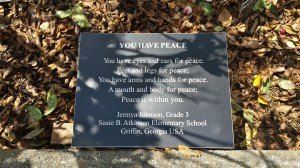
A peace poem from the MLK Jr. National Historic Site

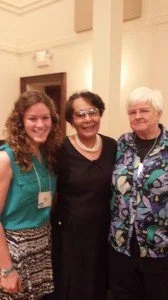
Mary Frances Early, the first African American woman to graduate from University of Georgia, Atlanta and Joan Browning, a Freedom Rider, at the Celebration of the Civil Rights Movement.

After traipsing through Atlanta for an entire week, facilitating tours to the MLK Jr. National Historic Sites, and participating in a Civil Rights Movement Celebration service I want to share only one story; a story of a woman I met at my last supper at Quadrennial.

Women who had purchased the Quadrennial meal plan would meet at meal time on a separate floor of the hotel to eat together. Each meal I sat with a different group of women from many different states and of many different ages. The diversity of strong women around me was inspiring.

At the last supper of the event, I was seated next to a woman named Sharon. About halfway through the meal Sharon and I got to talking about where she was from and what her life had been like. She explained that this was her 10th Quadrennial. 10th! With some quick math my thought process continued: “Quadrennial only occurs every 4 years… 10×4 is 40, she’s been attending for 40 years!” Imagine the women she’s met and the stories she’s heard and the changes she’s seen, like the fact that all of the Quadrennial registrations occurred online and most updates were sent out via e-mail. I wondered internally if the planners had to be more organized back when Quadrennial started because they didn’t have cell phones to call people when they weren’t on time to a worship rehearsal or whether they just ran all over town looking for people? and what kind of topics did they discuss? How did they travel? My mind reeled thinking about the differences between then and now.

Over the years Sharon had traveled from seven different states to Quadrennial and this time had flown all the way from Oregon to Atlanta on what was probably one of the farthest commutes of any woman within the U.S. She nonchalantly told me her story of growing up in rural Iowa and not having a bathroom in her house until she was in 12th grade, which showed me, yet again, a resounding change she had seen happen in her lifetime. She explained the love she felt from and for her siblings and how her and her husband had moved often throughout the west with their children.

She attended her first Quadrennial in Indiana as a physically younger woman. At this point in our conversation the song lyrics “I was older then, I’m so much younger now” from one of Bob Dylan’s songs popped into my head as her young spirit shimmered and gleamed. At that assembly she was randomly assigned to room with other young women from Puerto Rico who asked her questions she had never considered, like “how far do you have to walk to get your water” and “how far do you have to walk to get to church and to work?” Reminiscently she said “those women changed my life.” Even today, every time Sharon turns on a water faucet she is reminded of the things she takes for granted and how much those young Puerto Rican women challenged her ideas of the world.

After discussing her loving family and all the places she’d been, Sharon drew our conversation to a close saying with genuine honesty and heartfelt conviction “I must be the most blessed woman in the world.”

Just think about that statement for a moment–how powerful it is. “I must be the most blessed woman in the world.” The way she said those words and the way I could tell that she meant them with her whole heart bring forward waves of emotions in me, emotions I can’t describe with just a few measly words in this hastily thrown together blog that I write between activities at yet another camp.

Every day when I think about my life I don’t think about how blessed I am, I don’t think about the opportunities I’ve been given, like traveling around the country, seeing places I’ve never been before and being treated with such courageous compassion at every stop. And yes, everyday we’re told to “remember our blessings” and be thankful for what we have, but how can I ever truly think about it with a large enough scope? Will it take nine more Quadrennial Assemblies for me to internalize what Sharon discovered at her very first Quadrennial? I sure hope not.

As Sharon still remembers the women who opened her eyes and made an impact on her life at her very first Quadrennial I will always remember my very first Quadrennial when Sharon from Oregon left a mark on my soul in a mere 20 minutes over lasagna and iced tea, and will continue to remind me what it means to be the most blessed woman in the world.

Sincerely,

The Most Blessed Woman in the World


Cara McKinney is a 2014 Disciples Peace Fellowship Intern, sponsored by Disciples Center for Public Witness and Disciples Women.